Practice smarter with Prediction AI
WinJob Team
10/1/2026
Most interview practice is optimistic randomness. You pick a popular question, solve it, feel productive, and hope the real room rhymes. Sometimes it does. Often the interviewer stresses the one topic you postponed because it felt uncomfortable.
Prediction AI exists to shrink that guesswork. Given your target role, company context, and the evidence on your resume, it ranks the questions you should practice first, with confidence scores and a readiness picture that admits uncertainty.
The guesswork problem
Open question banks are useful and infinite. Infinity is the trap. Without a ranked shortlist, candidates default to comfort topics or viral problems that may not match the loop. Company research helps, but research alone does not turn into a practice queue with priorities.
The cost shows up late. You discover the gap in the interview, not in the week you still had to fix it.
Prediction AI: ranked questions for your loop
Prediction AI treats the interview as a prediction problem. You supply the target and the evidence. It returns a shortlist, typically on the order of five high-signal questions, each with a confidence score, key topics, and expected duration. The point is not prophecy. The point is a better prior than "whatever is on page one of Reddit."
What the output should change
A strong run does three things:
- Ranks risk. The first items are the ones most likely to hurt if you are cold.
- Shows confidence. An 88% confidence item deserves different urgency than a 55% speculation.
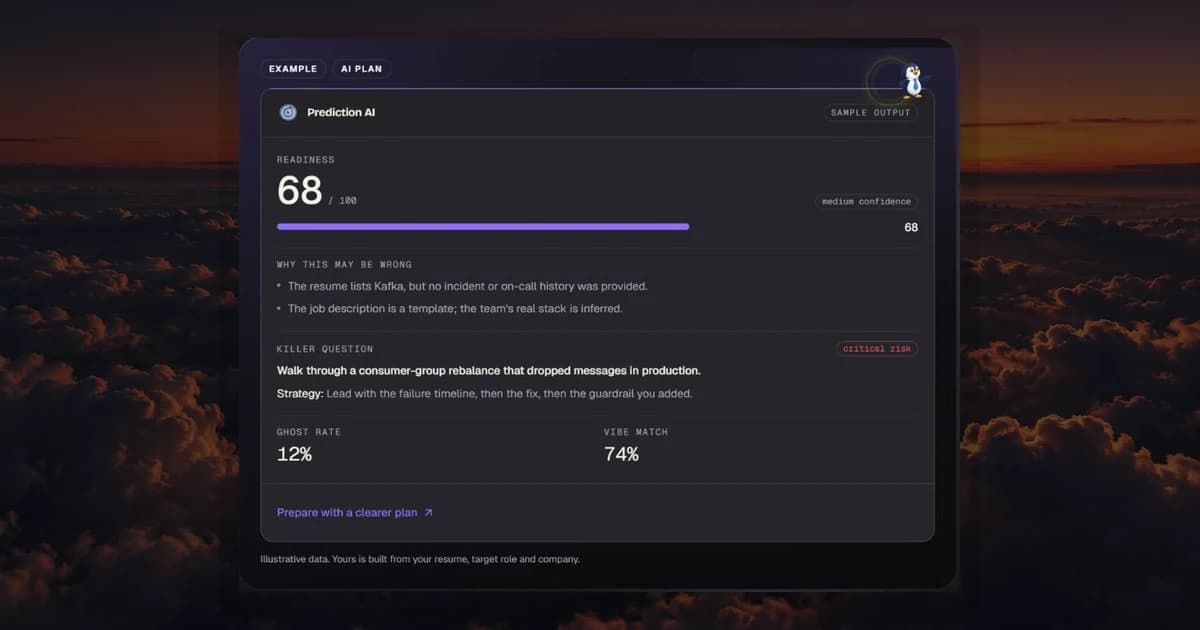
- Surfaces readiness. Companion readiness views (including Predictor-style bands on AI and Max plans) explain where you look solid, where you look thin, and why the model might be wrong.
That last part matters. WinJob's AI surfaces are designed to show doubt. If your resume lists Kafka but never mentions incidents, a readiness note should say so. Blind confidence is how bad tools get people hurt.
A concrete walkthrough
You are targeting a cloud architect role. You paste the posting and point Prediction AI at your resume. It returns a top set: rate limiting for a public API, webhook delivery under retries, consumer-group rebalance failure, multi-region failover story, and an observability design. Confidence is highest on the rate limiter and webhook items because the posting and your history both point there.
Your readiness band lands in the mid-sixties with medium confidence. The "why this may be wrong" notes call out a templated job description and missing on-call history. You do not argue with the model for sport. You schedule practice on the top two risks and add one real incident bullet to the resume if it is true.
That is smarter practice: fewer hours, sharper aim.
From prediction to reps
A ranked list only helps if it becomes calendar work. Move the top questions into Interview Sprint missions or into focused study inside Win System Design and the other libraries. Use authored walkthroughs for depth, then quizzes and flashcards to check retention.
When you need company-sourced signal rather than model priors, pair Prediction AI with Interview Research. Prediction ranks what to practice. Research shows what people report being asked. Together they beat either in isolation.
A practical weekly rhythm looks like this: run Prediction once when the loop is confirmed, lock the top three into sprint missions, deepen those three in the libraries, then re-check readiness after you finish the heavy practice. Do not re-roll predictions every night hoping for a kinder list. Stability beats novelty when the date is fixed.
Where Evaluator AI fits next
Prediction tells you what to practice. When the practice produces a diagram, Evaluator AI scores the design before a human does. Use Prediction to choose the prompt; use Evaluator to stress-test the answer. The next post walks that diagram loop in detail.
For today, the job is simpler: stop practicing the wrong five questions with total confidence.
Get a ranked practice list
Run Prediction AI on the role you are actually chasing, or sign up free to open the AI tools with a credit wallet you can read.
Practice the questions that can sink you. Leave the comfortable ones for later.