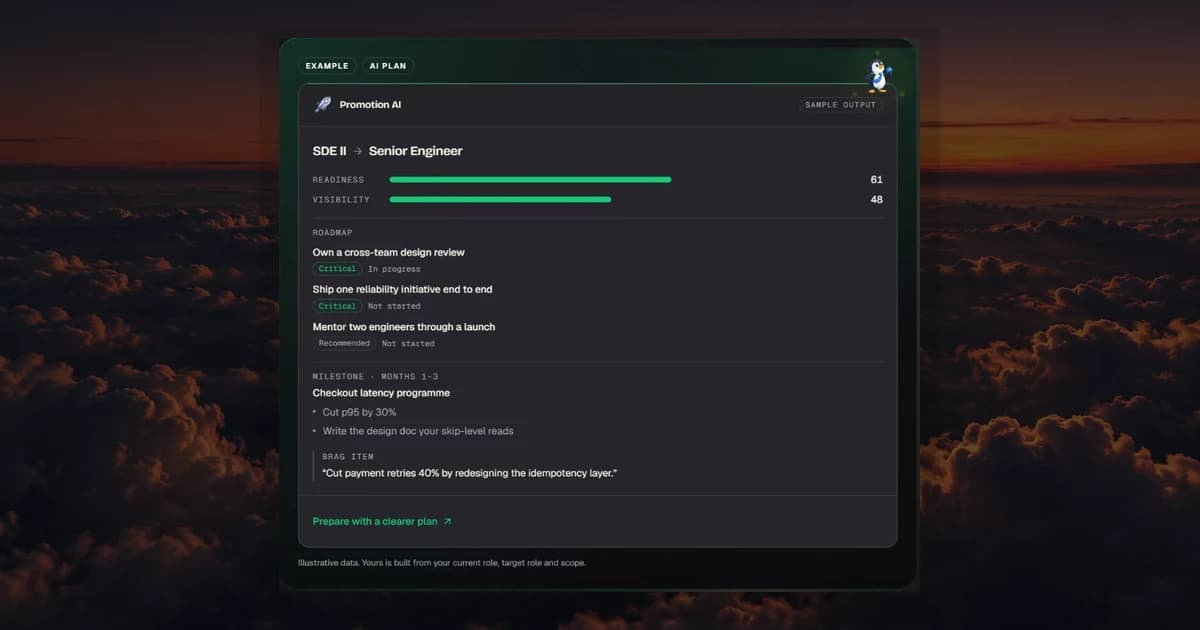
Promotions rarely fail because someone is "not smart enough." They fail because the packet is late, the evidence is fuzzy, and the conversation starts six months after the work already happened. Managers ask for impact. Calibration committees ask for scope. You show up with a list of tickets and hope the story writes itself.
Promotion AI is built for the other approach: treat the next level as a product with requirements, measure the gaps, then ship a roadmap of evidence while you still have runway.
Why promotion planning stalls
Most engineers wait for a signal. A peer gets leveled. A manager says "keep doing what you are doing." A job description for the next band appears in an internal wiki and somehow never becomes a personal plan.
Meanwhile the bar keeps moving. The work that got you to your current level is necessary and not sufficient. Cross-team influence, incident ownership, design review quality, mentoring, and business outcomes start to matter as much as raw delivery. Without a written gap list, you optimize for the wrong week.
Spreadsheets help until they become guilt. Self-reviews written in a panic the night before the deadline help even less.
What Promotion AI is for
Promotion AI turns a target level into a structured gap analysis. You describe where you are, the level you want, and the evidence you already have. It returns the deltas that matter: skills, scope signals, and proof points you still need to create at work, not only study about.
The output is not a pep talk. It is a working artifact: gap meters you can argue with, plus a roadmap of milestones that fit a real quarter.
The loop that works
- Name the target. Senior, staff, principal, EM track, IC track. Be specific about band language your company uses.
- Inventory the evidence. Projects shipped, incidents owned, designs reviewed, people mentored, metrics moved.
- Read the gaps. Treat each gap as a hypothesis. Keep what matches your manager's bar. Discard invented requirements.
- Execute the roadmap. Convert milestones into calendar work: lead a design review, own an on-call class of failures, publish a postmortem that changed process.
- Re-run before packet season. Update the evidence. Watch the meters move. Adjust the story before the form is due.
That is the same discipline good teams use for launches. Promotion AI just applies it to your career packet.
Gaps versus vibes
"I feel ready" is not a signal. "I closed the observability gap by owning the SLO dashboard and the weekly review for two quarters" is a signal.
Promotion AI is useful when it forces that translation. A vague strength like "strong communicator" becomes a proof request: design docs adopted by other teams, RFCs that landed, incident comms that reduced time to mitigation. A vague weakness like "needs more scope" becomes a concrete milestone: multi-team delivery with a written ownership map.
You still do the work. The AI does not invent a promotion. It makes the missing work visible early enough that you can choose it on purpose.
How this fits the Career OS
Promotion planning should not live in a silo next to interview prep. The same account that holds your resume stack, Interview Sprint, and course libraries can hold the promotion roadmap. Skills you close for a loop (system design clarity, AI literacy, cloud operational ownership) often show up again in the next-level bar.
If you are still hunting externally while aiming for an internal level-up, keep both tracks honest. A stronger packet helps you negotiate. A stronger external offer clarifies the market. WinJob is built so those tools share one login and one credit wallet instead of five subscriptions that never talk.
A sample quarter
Imagine you are an L4 backend engineer targeting L5 at a product company. Promotion AI flags three gaps: cross-team design leadership, measurable reliability ownership, and mentoring that leaves artifacts.
Your roadmap might look boring on purpose:
- Lead one cross-team design for a shared payments library and get written adoption from two consumers.
- Own the consumer-lag SLO for a Kafka path, including runbooks and two postmortems with follow-ups closed.
- Mentor two engineers through design reviews with notes they can reuse.
None of that is glamorous. All of it is packet-grade. When packet season arrives, you are assembling evidence, not inventing a narrative.
Start before the deadline
If your next review is already on the calendar, open Promotion AI this week, not the week the form is due. If you are new to WinJob, create a free account and bring a real target level, not a fantasy title.
Pair the roadmap with the libraries when a gap is knowledge-shaped: Win System Design for architecture depth, Win AI, Win Cloud, or Win Ops when the bar names those domains. Pair it with Interview Sprint if you are also preparing external loops in parallel.
Promotions favor people who treat the next level like a project. Give the project a plan.